Stepping Out of the Zone of Fire

In hierarchal organizations, people are encouraged to have a clear Zone of Fire. Zone of Fire is a concept from the military. If you are in a firing line, you are assigned a defined area, your Zone of Fire. If an enemy enters your Zone, you fire; if an enemy enters somebody else’s area, you don’t fire. Your job is to keep your eye on your own Zone and to ignore the rest.
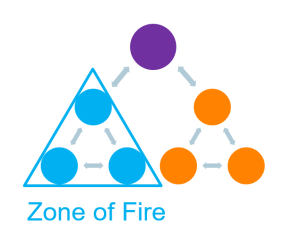
ZoneofFireFig
Women are punished for being “outspoken” when they step outside of their designated Zone of Fire.


Zone of Fire is the fundamental basis of hierarchy. Most organizations are divided into divisions and groups within those divisions, each with a defined purpose. Though you would be hard pressed to find an organization that claims they encourage silos, the Zone of Fire is quite strictly enforced.

Here’s an example from many years in my past. I disagreed with the email policy of a former employer. Wanting to be proactive, I found the name of the executive in charge of IT and send him a polite email expressing why I thought the policy should be changed. I felt good about taking action. Instead of just complaining to my colleagues, I had opened the possibility that the policy could be changed.

Alas, email policy was far outside of my Zone of Fire. The result was a negative mention in my annual review, some six months later. The comment was not that I should stay within my Zone, or mind my own business. The Zone of Fire is seldom acknowledged so transparently. Instead, I was told I should have called instead of emailed. Looking back, I am confident that a phone call would have been met with the same reaction.

I’ve lived in hierarchies for over 20 years, and I only started to understand the Zone of Fire within the past 6 months. Why has it taken me so long? Because the Zone of Fire is as unnatural to women as it is presumed by men. And even now that I understand the Zone of Fire, I find it almost impossible to obey the rules of the Zone.

When women hear about a problem, they tend to speak up, regardless of whether it falls within their Zone of Fire. Why? Because they care about the organization, and they have a sincere belief that management will “want to know.” And if they were in the same situation, they would indeed want to know.

For men, it is more important to respect the Zone of Fire of an adjacent manager. For men, expressing concern would convey a lack of confidence that the adjacent manager is able to effectively control their Zone of Fire.

The Zone of Fire is one reason why female leaders have ubiquitously been told they are too outspoken. It’s not merely a judgment that they are too assertive. They are speaking outside of their Zone of Fire and disobeying the rules of the hierarchy. Rules that they do not instinctually understand.

I’ve written before about my belief that the ability to synthesize diverse perspectives will be the competitive advantage of the future. Loosening the grip of the Zone of Fire within our organizations is one step we can take towards that future.


Diversity is Our Future

Abstract background of multi-colored cubes

The world has changed. As an engineer, I remember when engineering was the hard stuff. Now, when I look at major projects, the engineering is rarely the greatest hurdle a project has to overcome. The hard stuff is getting rate payers to accept the rate increases needed to maintain and build new infrastructure. Getting the buy-in of neighbors affected by projects that may not benefit them. Addressing impacts to our natural resources in a way that maintains affordability. Balancing the needs of today with the needs of tomorrow.

The challenges of today are distinctly different from those of the past:

  • Our challenges are multi-faceted – there is no one person with the expertise to address these challenges. The list of needed expertise is long: engineering (we are still on the list!), community engagement, public affairs, environmental science, asset management, risk analysis, sustainability, and on and on.
  • The boundaries around our problems are getting fuzzy – The public wants public agencies to work together and develop projects that meet multiple needs. This is not just a matter of “What’s in it for me?” It’s a growing recognition that multi-benefit projects represent the greatest overall value to the community for their investment dollars. Especially as engineers, our nature is to put a hard boundary around a project, clearly delineating what is in and what is out. We need to see projects with new eyes, seeing how they interconnect with the community and the world.
  • We cannot face our challenges in isolation – Total demands on our water resources and our funding are outstripping supply. This is driving the integrated, one water approach bringing together water, wastewater, and surface water. It is also driving our integration with agencies and interests we may not have interfaced with in the past. We are now living in a world of complex partnerships and decision making structures, and the path forward is much less linear.

All of these challenges demand more than just individual innovation. Meeting challenges now requires the synthesis of many ideas and perspectives into solutions that no single individual could have developed. The challenges of today demand diversity. Diversity of thinking, diversity of expertise, diversity of background, diversity of relationships. Organizations that are able to harness diversity, to synthesize rather than homogenize, will have a distinct competitive advantage in the future.

One misconception about diversity is that diversity is just about getting more women and people of color into leadership roles. The misconception is that we can achieve diversity without transforming our organizations, without transforming our thinking. This fallacy is one of the reasons why we haven’t seen more progress in diversity in the leadership of our organizations.

A diverse organization is one where many voices can be heard. Where people are open to new ideas, no matter where they come from in the hierarchy. Where people are willing to put in the effort to challenge their own thinking. Where leaders are harnessing the ideas and vision of the whole organization. Where everyone is accountable for fully taking their seat at the table. Where bringing the full breadth of one’s experience and thinking to work is not just tolerated, it’s a core part of the organization’s success.

The characteristics of a diverse organization are the same characteristics we need to face the challenges of today. We need to change our organizations and change our thinking. As stewards of our precious water resources, it is not only the right thing to do, it is the necessary.

Who would we be without our story?

I had lunch yesterday with a pretty amazing GenX. Yes, he is another engineer, but he dreams of changing the school system so that personal development gets as big a play as chemistry or physics. Of course, he pointed out that this dream would never happen because he thought it improbable that Obama was going to call him up to revise national curriculum standards. Alas, this made me think of some pretty (non) amazing thing about our generation.

1. The oh so defeating habit of black and white thinking. The way he was seeing it was either (A) Obama calls or (B) there is nothing to be done. This kind of thinking is common, not only among GenX. But I think in our case it may just be somewhat conveniently self-defeating. We manage to make the dream side of the equation so overwhelmingly huge and impossible, that we can’t help but choose not to pursue it. Of course, in reality, there are all sorts of shades of gray. Because he’s right – Obama is not going to call.

2. We are constantly cutting ourselves off at the knees. There is something about the “practical” tendencies of GenX that can really get in the way of being clear about what we want. We are so busy arranging and modifying what we want based on what we think is possible, that it is hard to remember what we were wanting in the first place. I am not a believer that everyone can live their passion or dream exactly how they want it (and still make a living). But, I do think there is something to be said for actually being clear on what you want.

3. We could learn a lot from GenY. Needless to say, there are many things they could learn from us. But, one thing they’ve got down is they being clear on what they like and want. Perhaps it’s because they’ve been declaring their preferences online since they were kids, or because they grew up in a child-centric world, but I just don’t see the same tendency to let practicality get in the way of their passion. They are frankly much worse at faking interest in things they aren’t interested in, whereas we have a pretty easy time focusing on assimilating skills that are marketable, whether or not we find them personally interesting or fulfilling. There is something really pure about that aspect of GenY – aside from making for a lot of highly entertaining YouTube Videos it also creates a lot of possibilities for change in the world.

It all made me think about the words of Byron Katie “Who would you be without your story?” Who would we be without our story? This story we have about being powerless and unable to create the changes we want to see in the world. What would the world be like without our story?

As for my friend, he did end up envisioning all sorts of possibilities that were not so far beyond his reach. Which is a good thing, because the world needs us and our ideas. If you dropped your story, how would you be changing the world?

Can GenX have its cake and eat it too?

For many GenExers, empowerment at work is defined as knowing that they can walk out whenever they want. In my experience, they usually have a back-up plan to facilitiate this sense of “security” which I’ll call Plan B – this is the sensible back-up plan, comprised of everything from building marketable skills to knowing which other firms might hire you in a pinch. A GenXer without a Plan B is an unhappy GenXer.

But this isn’t the only back-up plan. Most GenExers I know have a Plan F – which would be Plan Fantasy. This invariably includes starting their own business of some sort – which is why I used to refer to this as the “retail phenomenon.” I had noticed that many of my peers harbored dreams of starting some sort of retail business – bakeries, clothing stores, flower shopes, the list goes on. The important thing was that it represented a strong personal interest – basically, it’s a business that is a true expression of the individual ( a strong source of meaning for GenX). Most GenXers dream of quitting their regular job and living their Plan F . However, because of a combination of GenX practicality and cynicism, few of these Plan Fs ever see the light.

So, I’m going to throw out an idea that maybe GenX should take a middle road – of having their cake and eating it too. Meaning, having their meaning (dream) and keeping their corporate job. Perhaps it is not just a choice between working for the man (financial security) and taking Plan F (having a meaningful life). Maybe what is needed is a new army of part-time workers who spend half their time in corporate america, and the other half building businesses that reflect their passions. I would hypothesize that the energizing effect of the side businesses would in many cases improve performance in their corporate jobs.

It is considered completely acceptable at many companies for mothers to work part-time when they have small children (and I’m sure at some enlightened companies this attitude would extend to dads). But working part-time to engage in another business activity would be seen as just a step out the door. But what if it were not? Would this finally engage GenXers en masse in their organizations?

Smokers give me hope

When I was in college I remember my boyfriend (yes, I’m talking about you Mike) insisting on walking on the road side of the sidewalk. I found this to be quite a ridiculous convention, pretending to periodically attempt to fling myself into oncoming traffic.

I would still be more than willing to give up such formal manners. But I do find myself missing some common courtesies. Namely, now that I am often accompanied by a stroller, I am horrified to realize how infrequently strangers offer to hold the door open for me. Yes, people just stand there are watch me struggle, apparently with no thought to just hold the door open. This includes people who are actually WAITING to go through the door!

Similarly, here in Portland, cars see almost no reason to ever stop to let someone cross. This includes a woman who is 8 months pregnant, carrying a 2-year old, who is at a crosswalk. I can very reasonably describe this as commonplace (even the statistical median of my experience).

Now, back to the smokers. Funny enough, the most common courtesy I witness in my area of town is from smokers. I find that when smokers see me approaching with a stroller, they routinely hold their cigarette away from me to keep the smoke away from my kids. This simple act of consideration is usually delivered with a smile.

Mind you, I happen to hate cigarette smoke. And I really understand that younger generations are not so commited to conventions of the past. But please, can’t we just let go of the “rules” that don’t make any sense, while still maintaining some level of social decency! Apparently, for all they are often either vilified or disparaged, smokers seem to be the last decent people living in my neighborhood. So, long live the smokers – hmm, oxymoron?

Message from a lost generation

I’ve long been fascinated by generational differences in the workplace. Well, to be more honest, I’ve long been fascinated by my own generation – in case, you hadn’t figured it out, that would be GenX. I suppose in the end, that just means I’m fascinated by myself, but what can I say, it always helps to start with a test case.

Reading about GenX was when I first tapped into how deeply cynical I am. And this is me – a person whom I believe many would describe as almost annoyingly upbeat and ready to conquer the world. But the truth is that I can be as cynical as any GenXer – especially when it comes to organizations and the possibility that they can ever change.  

But lately in the media, all I ever hear about is Millennials or GenYs, whichever you prefer to call them. Though I realize many are tearing out their hair trying to integrate the new generation into the workplace, all I can think is “what about me?!” Okay, to be sound a bit less egocentric, my real concern?  Is GenX just turning into a lost generation? Are we going to be like Prince Charles, with the throne being passed right over our head (as Kate Middleton seems to be on the cover of every magazine I see, I am thinking royal family references still work in the U.S.)?

Alas, it seems like we may be lost in two senses of the world – both in the sense of becoming invisible, and also in the sense of being lost in our search for meaning.

So, I decided to start a blog. Both to share the thoughts whipping around my brain about my generation, plus some some adjacent random musings that are likely completely unrelated to my birth year.