Stepping Out of the Zone of Fire

In hierarchal organizations, people are encouraged to have a clear Zone of Fire. Zone of Fire is a concept from the military. If you are in a firing line, you are assigned a defined area, your Zone of Fire. If an enemy enters your Zone, you fire; if an enemy enters somebody else’s area, you don’t fire. Your job is to keep your eye on your own Zone and to ignore the rest.
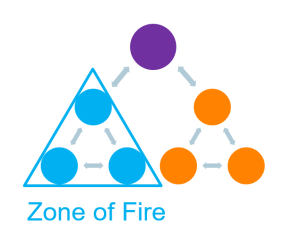
ZoneofFireFig
Women are punished for being “outspoken” when they step outside of their designated Zone of Fire.


Zone of Fire is the fundamental basis of hierarchy. Most organizations are divided into divisions and groups within those divisions, each with a defined purpose. Though you would be hard pressed to find an organization that claims they encourage silos, the Zone of Fire is quite strictly enforced.

Here’s an example from many years in my past. I disagreed with the email policy of a former employer. Wanting to be proactive, I found the name of the executive in charge of IT and send him a polite email expressing why I thought the policy should be changed. I felt good about taking action. Instead of just complaining to my colleagues, I had opened the possibility that the policy could be changed.

Alas, email policy was far outside of my Zone of Fire. The result was a negative mention in my annual review, some six months later. The comment was not that I should stay within my Zone, or mind my own business. The Zone of Fire is seldom acknowledged so transparently. Instead, I was told I should have called instead of emailed. Looking back, I am confident that a phone call would have been met with the same reaction.

I’ve lived in hierarchies for over 20 years, and I only started to understand the Zone of Fire within the past 6 months. Why has it taken me so long? Because the Zone of Fire is as unnatural to women as it is presumed by men. And even now that I understand the Zone of Fire, I find it almost impossible to obey the rules of the Zone.

When women hear about a problem, they tend to speak up, regardless of whether it falls within their Zone of Fire. Why? Because they care about the organization, and they have a sincere belief that management will “want to know.” And if they were in the same situation, they would indeed want to know.

For men, it is more important to respect the Zone of Fire of an adjacent manager. For men, expressing concern would convey a lack of confidence that the adjacent manager is able to effectively control their Zone of Fire.

The Zone of Fire is one reason why female leaders have ubiquitously been told they are too outspoken. It’s not merely a judgment that they are too assertive. They are speaking outside of their Zone of Fire and disobeying the rules of the hierarchy. Rules that they do not instinctually understand.

I’ve written before about my belief that the ability to synthesize diverse perspectives will be the competitive advantage of the future. Loosening the grip of the Zone of Fire within our organizations is one step we can take towards that future.

Diversity is Our Future

Abstract background of multi-colored cubes

The world has changed. As an engineer, I remember when engineering was the hard stuff. Now, when I look at major projects, the engineering is rarely the greatest hurdle a project has to overcome. The hard stuff is getting rate payers to accept the rate increases needed to maintain and build new infrastructure. Getting the buy-in of neighbors affected by projects that may not benefit them. Addressing impacts to our natural resources in a way that maintains affordability. Balancing the needs of today with the needs of tomorrow.

The challenges of today are distinctly different from those of the past:

  • Our challenges are multi-faceted – there is no one person with the expertise to address these challenges. The list of needed expertise is long: engineering (we are still on the list!), community engagement, public affairs, environmental science, asset management, risk analysis, sustainability, and on and on.
  • The boundaries around our problems are getting fuzzy – The public wants public agencies to work together and develop projects that meet multiple needs. This is not just a matter of “What’s in it for me?” It’s a growing recognition that multi-benefit projects represent the greatest overall value to the community for their investment dollars. Especially as engineers, our nature is to put a hard boundary around a project, clearly delineating what is in and what is out. We need to see projects with new eyes, seeing how they interconnect with the community and the world.
  • We cannot face our challenges in isolation – Total demands on our water resources and our funding are outstripping supply. This is driving the integrated, one water approach bringing together water, wastewater, and surface water. It is also driving our integration with agencies and interests we may not have interfaced with in the past. We are now living in a world of complex partnerships and decision making structures, and the path forward is much less linear.

All of these challenges demand more than just individual innovation. Meeting challenges now requires the synthesis of many ideas and perspectives into solutions that no single individual could have developed. The challenges of today demand diversity. Diversity of thinking, diversity of expertise, diversity of background, diversity of relationships. Organizations that are able to harness diversity, to synthesize rather than homogenize, will have a distinct competitive advantage in the future.

One misconception about diversity is that diversity is just about getting more women and people of color into leadership roles. The misconception is that we can achieve diversity without transforming our organizations, without transforming our thinking. This fallacy is one of the reasons why we haven’t seen more progress in diversity in the leadership of our organizations.

A diverse organization is one where many voices can be heard. Where people are open to new ideas, no matter where they come from in the hierarchy. Where people are willing to put in the effort to challenge their own thinking. Where leaders are harnessing the ideas and vision of the whole organization. Where everyone is accountable for fully taking their seat at the table. Where bringing the full breadth of one’s experience and thinking to work is not just tolerated, it’s a core part of the organization’s success.

The characteristics of a diverse organization are the same characteristics we need to face the challenges of today. We need to change our organizations and change our thinking. As stewards of our precious water resources, it is not only the right thing to do, it is the necessary.