
Diversity is Our Future

Abstract background of multi-colored cubes

The world has changed. As an engineer, I remember when engineering was the hard stuff. Now, when I look at major projects, the engineering is rarely the greatest hurdle a project has to overcome. The hard stuff is getting rate payers to accept the rate increases needed to maintain and build new infrastructure. Getting the buy-in of neighbors affected by projects that may not benefit them. Addressing impacts to our natural resources in a way that maintains affordability. Balancing the needs of today with the needs of tomorrow.

The challenges of today are distinctly different from those of the past:

  • Our challenges are multi-faceted – there is no one person with the expertise to address these challenges. The list of needed expertise is long: engineering (we are still on the list!), community engagement, public affairs, environmental science, asset management, risk analysis, sustainability, and on and on.
  • The boundaries around our problems are getting fuzzy – The public wants public agencies to work together and develop projects that meet multiple needs. This is not just a matter of “What’s in it for me?” It’s a growing recognition that multi-benefit projects represent the greatest overall value to the community for their investment dollars. Especially as engineers, our nature is to put a hard boundary around a project, clearly delineating what is in and what is out. We need to see projects with new eyes, seeing how they interconnect with the community and the world.
  • We cannot face our challenges in isolation – Total demands on our water resources and our funding are outstripping supply. This is driving the integrated, one water approach bringing together water, wastewater, and surface water. It is also driving our integration with agencies and interests we may not have interfaced with in the past. We are now living in a world of complex partnerships and decision making structures, and the path forward is much less linear.

All of these challenges demand more than just individual innovation. Meeting challenges now requires the synthesis of many ideas and perspectives into solutions that no single individual could have developed. The challenges of today demand diversity. Diversity of thinking, diversity of expertise, diversity of background, diversity of relationships. Organizations that are able to harness diversity, to synthesize rather than homogenize, will have a distinct competitive advantage in the future.

One misconception about diversity is that diversity is just about getting more women and people of color into leadership roles. The misconception is that we can achieve diversity without transforming our organizations, without transforming our thinking. This fallacy is one of the reasons why we haven’t seen more progress in diversity in the leadership of our organizations.

A diverse organization is one where many voices can be heard. Where people are open to new ideas, no matter where they come from in the hierarchy. Where people are willing to put in the effort to challenge their own thinking. Where leaders are harnessing the ideas and vision of the whole organization. Where everyone is accountable for fully taking their seat at the table. Where bringing the full breadth of one’s experience and thinking to work is not just tolerated, it’s a core part of the organization’s success.

The characteristics of a diverse organization are the same characteristics we need to face the challenges of today. We need to change our organizations and change our thinking. As stewards of our precious water resources, it is not only the right thing to do, it is the necessary.
5 Completely Obvious Things Anyone Could List

As somebody new to twitter who has been reading a whole lot of blog posts lately, I can’t help but notice that the quality is, shall we say, highly variable. I’m pretty sure I could spend my whole life just reading lists of completely obvious things, so here’s my list.

  1. If you want to be trusted you need to trust people first

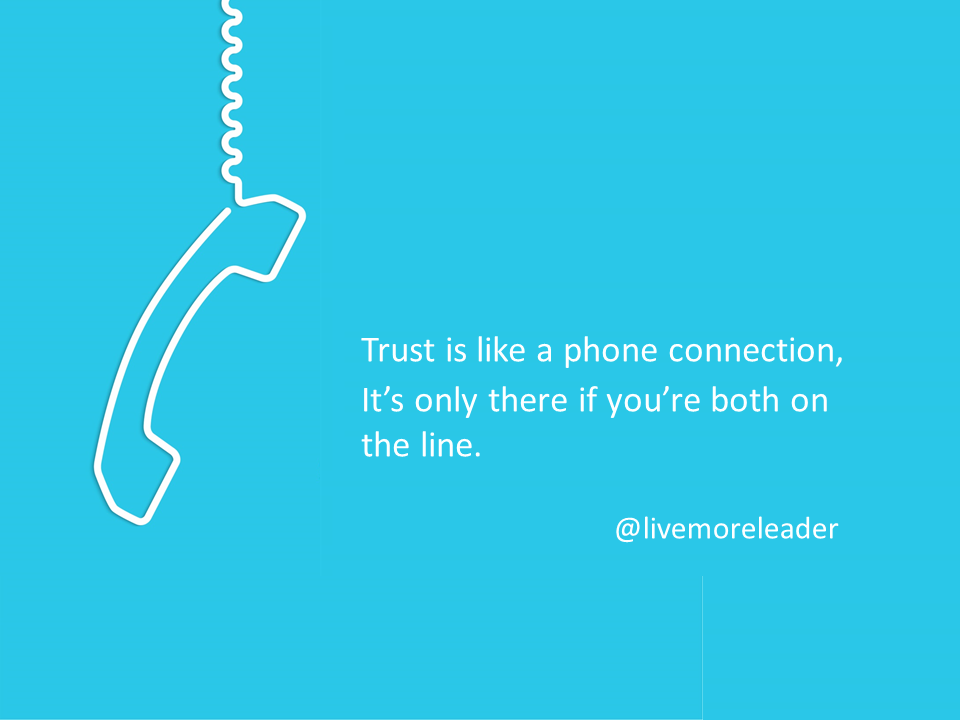
This really should be obvious, but I’ve noticed it is a bit of a blind spot for those who have a hard time trusting. They think trust is something you can just earn or give away, like a coin. Actually, trust is more like a phone connection, it’s not there unless both of you are on the line.

Phone connection trust illustration

  1. Don’t be mean, people don’t like that

Let’s be honest, leaders have to say a lot of hard things. Some of those things, people aren’t going to like. But, there is a big difference between saying things that are hard and being mean, and people notice. Indeed, a coworker once noted it was mysterious to him that I am really tough but people don’t hate my guts. He pinned it down to “you are never mean to people.” Whaddayaknow? That actually makes a difference!

  1. You can curse with people, but not at them

I actually offered this up as a piece of mentoring advice to a protégé about a month ago. It was a bit tongue in cheek, but in my opinion, rather sound advice. Cursing in the workplace can be fun, it builds camaraderie in the tough times, helps break the ice, can help build authentic trust (I swear!). But you absolutely must not swear at people. Because that is mean, and rude, and you will regret it.

  1. If you want to be respected, you absolutely must not show the world your cleavage

I work in a male-dominated field, so I realize this rule may not apply everywhere. But I imagine it applies most places. If you want to be respected, you need to keep it under wraps, because once you have revealed yourself, so to speak, it just can’t be undone. I’ve seen a lot of younger professionals make the mistake of too sexy clothing or the friendly flirt. Great if you intend to stay a junior engineer forever, not so great if you plan to advance in the world. Now in case you want to accuse me of being sexist, I will note that this rule applies equally to men.

  1. Everyone is afraid

I’m going to admit that everyone is not equally afraid. But they are afraid. Knowing this fact is one of the keys to confidence. People who lack confidence manage to think they are the only ones. Several years ago I had a coworker say to me “But Nicki, you aren’t ever afraid are you?” Well, yes indeed I am, very frequently, just like everyone else. You know why? Because I am not a sociopath.

Hmm, now I am getting the urge to write 5 completely obvious things about parenting. Sounds risky, but I hear fear is completely natural!

Transformation starts with meeting people where they are

Are you standing your ground and missing an opportunity to make a difference?

This year I had the pleasure to attend a Duarte training based on the books Resonate and Slideology. I learned a lot about presentations, but also something more. I realized that transformation starts with meeting people where they are. In Duarte we were talking about connecting emotionally during presentations, at the heart center, but it is equally as true at the gut center and head center. And here’s how:

  1. Connecting Emotionally at the Heart Center

I’ve done a whole lot of PowerPoint in my life, but I learned one thing at the training that transformed the way I see presentations. In the past I’ve thought a lot about walking the audience through a story, but Resonate takes it a step further by focusing on the audience’s emotional state ~ both where they are at now and where you want to take them. Nancy Duarte (@nancyduarte) also discovered a pattern common to great speeches, where they alternate between where the audience is now and the future condition you want to take them to. People are not transformed in the first iteration, you have to keep going back to bring them with you!

  1. Connecting Energetically at the Gut Center

For the gut center, it made me think of the amazing book “Winning Body Language” by Mark Bowden. One topic Mark covers is four “planes” at which you can hold your arms, which correspond with increasing levels of energy as your arms move up through the levels. They start with the Grotesque Plane with arms at your sides all the way through the Ecstatic Plane with your arms above shoulder level. That correlation is in itself fascinating (and I highly recommend the book) but the aspect that relates to transformation is the fact that if you want to change the energy level of an audience you need to start by meeting them where they are. Indeed, if you are more than one level separated from your audience, you will feel dissonant. I imagine you may have experienced this, being in a pretty “dead” audience first thing in the morning and being subjected to a very high energy presenter. When the audience energy is low, the high energy speaker feels more manic than energizing! As a high-energy person who works with a lot of lower energy engineers, I use the techniques in the book to consciously bring my energy level down.

  1. Connecting Intellectually at the Head Center

When it comes to the head center, it makes me think of a conversation I had with a protégé some months ago. She is passionate about changing the organization she works for, intentionally deviating from organizational norms in an effort to show an alternate way of thinking. Instinctually, her reaction when a small action doesn’t create change is to try an even larger action. I have to admit I was doing pretty much exactly the same thing when I was in my twenties. The greatest insight of my twenties could be well summed up as, “people don’t care about what they don’t care about.” The advice I gave her is that if she wants to change the organization she needs to start by meeting the company leadership where they are, then help them move from that position. It doesn’t work to just stand in her corner and yell louder and louder.

So how does this apply to leadership? As leaders we can use the same principle ~ transformation starts with meeting people where they are. This means acknowledging and connecting with where they are energetically, emotionally and intellectually then moving them towards a different future. Joining them where they are is commiseration, talking about a positive future disconnected from current reality is just dissonance. Taking them on a journey from where they are to a new place ~ now that is leadership.

What about you? Is there a situation in your life where you are holding your ground and missing an opportunity for transformation?

#Womensleadership #GenY #leadershipdevelopment #resonate #bodylanguage

The ambivalent overachiever – a new GenX breed?

Overachievers of past generations seemed to aim straight for the top – seemingly to presume that if you could get to the top that you should. Alas, I believe GenX has created a new breed – the ambivalent overachiever. This breed is not so obsessed with whether they can get to the top, but whether they want to. There is a sense that such ambivalence would not be so appreciated by the powers that be, so most ambivalent overachievers are out there masquerading as “normal” dedicated employees. They are indeed often quite successful, as GenXers tend to be rather perceptive about how to play the game (if they choose to play it).

The overachievement part is motivated by a variety of factors. First and foremost – success gives you options. And every GenX knows that options are power. Overachievement probably means you can walk out the door, if things are not working out. Very important even if you are actually quite happy with your current employment. 

Of course, ambivalent or not, many of us overachieve simply because we actually care about what we are doing. Even if it not our dream job (our Plan F), there is some meaning to be gained from just doing something well, to doing your best. Part of this is not just about what we are doing, but who we are doing it for. Though GenXers are notoriously cynical about organizations, we can still be inspired by and loyal to people ~ whether those people are clients, coworkers, or “the boss.”

The question is, can this breed become the next generation of leaders? Can leadership and ambivalence coexist? It seems that the GenX habit of having one foot subconsciously out the door may be incompatible with leadership. Or maybe it is just going to change the way leadership looks and feels. The question is, can you be an effective leader in an organization without drinking the kool-aid? What do you think?